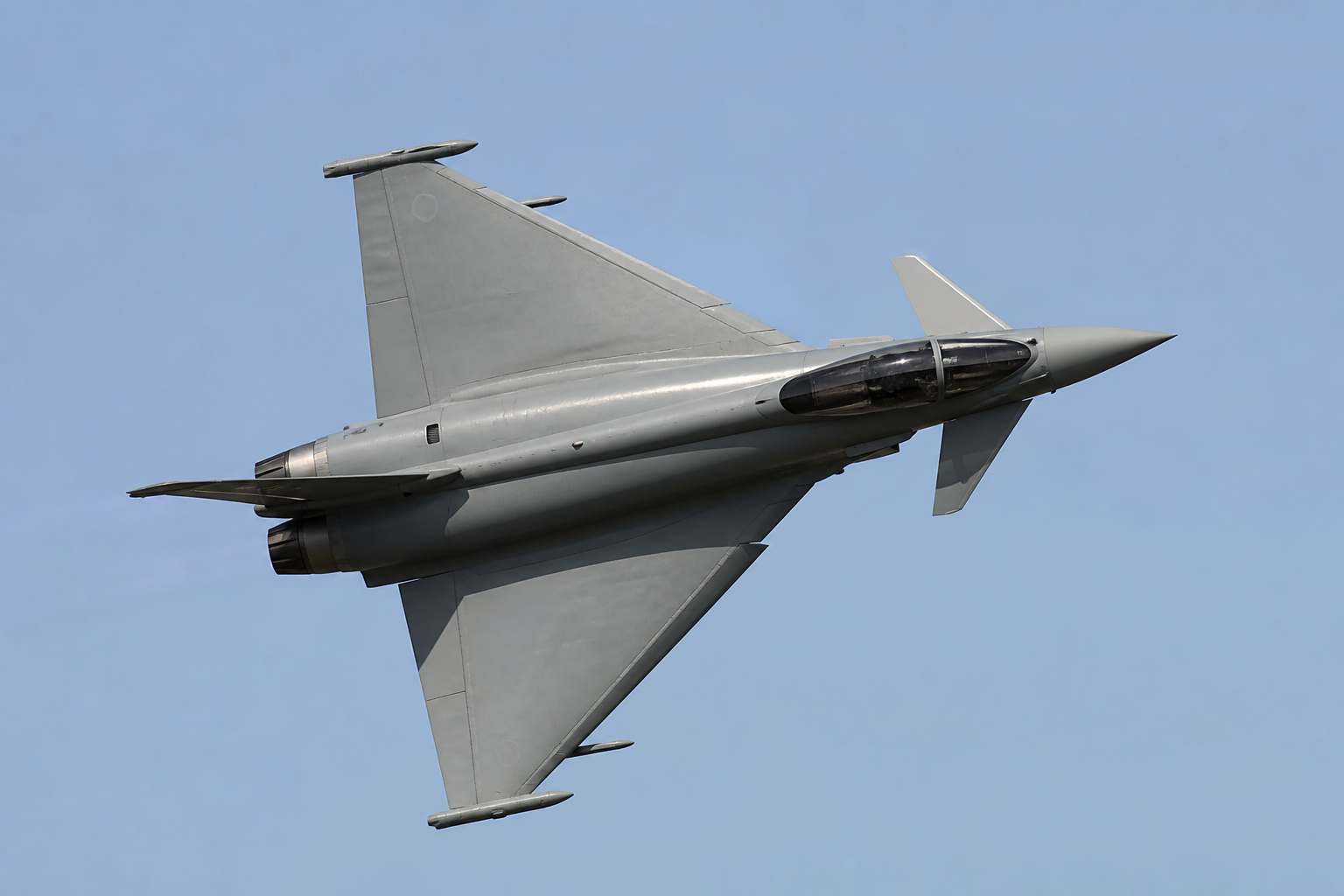
The Eurofighter Typhoon is a twin-engine, canard-delta multirole fighter developed by a European consortium for air superiority and later expanded strike roles. Partner nations have included the United Kingdom, Germany, Italy, and Spain, with additional export customers. It remains a core combat aircraft for several NATO air forces, including the German Luftwaffe.
The canard-delta layout places small foreplanes ahead of a large delta wing. In public aerospace writing, that arrangement is associated with high agility, strong instantaneous turn performance, and flexible external stores carriage—useful for a jet expected to fly both air-to-air and air-to-ground sorties with different loadouts.
Typhoon is a fourth-generation-plus design: not a low-observable internal-bay stealth fighter like the F-35, but a high-performance jet with advanced radar and electronic warfare growth paths. Its combat value in allied fleets often comes from energy maneuverability, missile employment, and integration into NATO datalink networks rather than broadband stealth.
Twin engines provide thrust margin and a measure of redundancy. Afterburner climbs and rapid acceleration—visible in many public airshow and training photographs—are operationally relevant for intercept timelines and for recovering energy after turning fights. Exact thrust and empty-weight figures vary by tranche and national configuration, so responsible summaries avoid inventing a single universal number.
Like other Western fighters, Typhoon capability is as much software and weapons clearance as airframe. Meteor beyond-visual-range missiles, precision air-to-ground munitions, and AESA radar upgrades (where fitted) change the jet’s mission set without altering its basic silhouette.
For industry readers, Typhoon illustrates a long multinational production and upgrade lifecycle: common core design, national differences in defensive aids and weapons, and continuous combat-capability insertions. That model is slower than a single-nation sprint—but it spreads cost and creates deep maintenance ecosystems across partner countries.