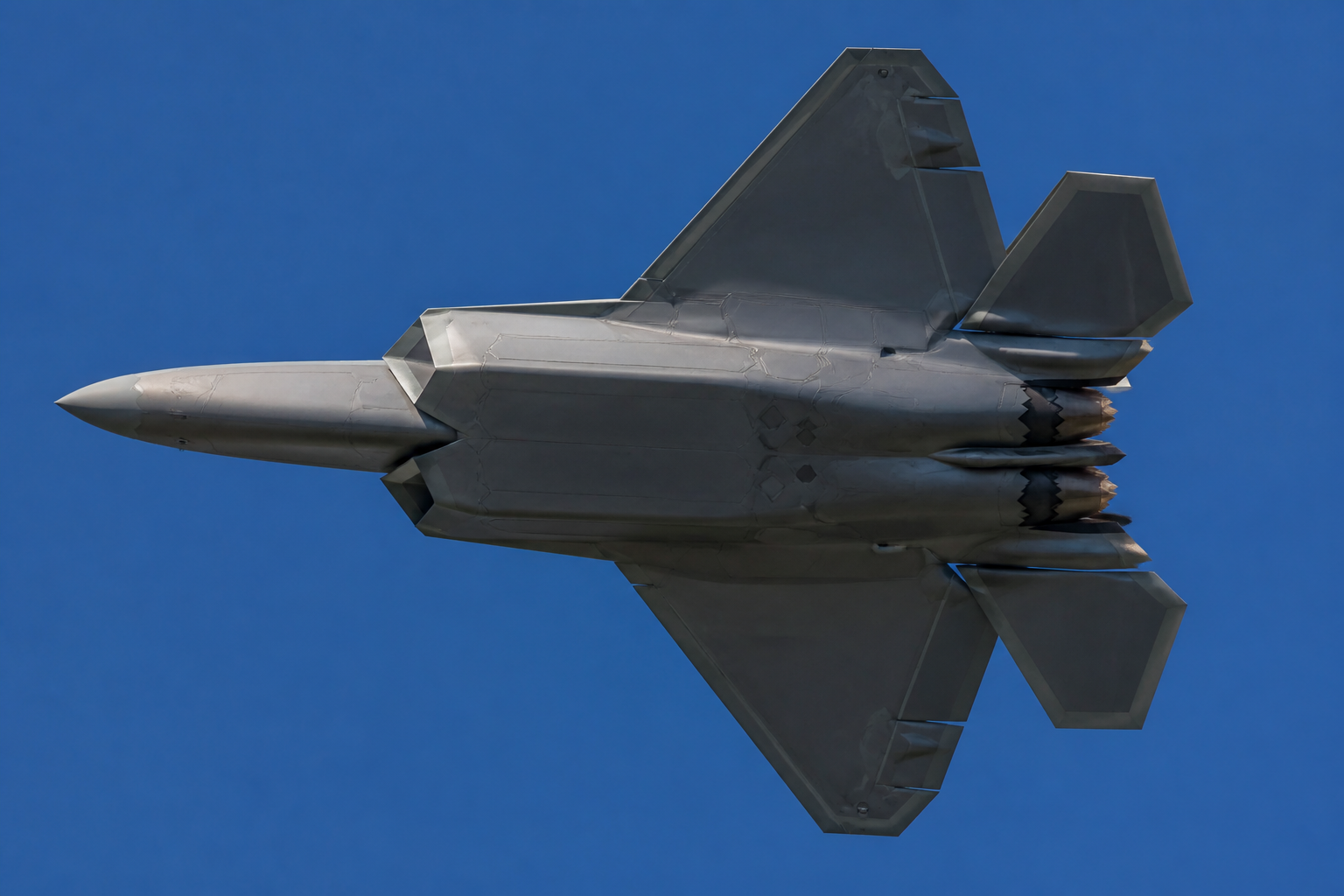
“Fifth-generation” fighter is a shorthand for a package of attributes: low observable design, advanced sensors, sensor fusion, networked communications, and internal weapons carriage for reduced radar signature on day-one missions. The F-35 Lightning II is the most widely fielded aircraft in that category among Western air forces.
According to the manufacturer’s public F-35A product data, the conventional takeoff and landing A-model is about 15.7 m long with a 10.7 m wingspan. Published performance includes a top speed of Mach 1.6, a maximum g-rating of 9.0, internal fuel capacity of roughly 8,278 kg (18,250 lb), a combat radius greater than 1,093 km (590 nmi) on internal fuel, and a ferry-style range above 2,200 km (1,200 nmi) on internal fuel.
Propulsion is the Pratt & Whitney F135-PW-100. Public thrust figures list about 40,000 lbf with afterburner and about 25,000 lbf in military (dry) power. Weapons payload is publicly listed at up to about 8,160 kg (18,000 lb), with internal bays used when signature management is prioritized and external stations available when the mission accepts a larger radar cross-section.
What often separates the F-35 from legacy fourth-generation jets in operational writing is sensor fusion: combining radar, electro-optical, electronic warfare, and datalink inputs into a single tactical picture for the pilot. That reduces workload and can make the aircraft a forward sensor node for other shooters, not only a self-contained dogfighter.
Modernization continues through Block 4 capability growth and Tech Refresh-3 (TR-3) mission-systems hardware, which the manufacturer describes as adding processing, display, and open-architecture capacity for future software. Public communications emphasize electronic warfare upgrades, weapons capacity growth, and improved target recognition—not a change to the basic airframe geometry.
For defense planners, the F-35 case study is less about a single top-speed number and more about whether a force can sustain software, spare parts, mission data files, and trained maintainers. Fifth-generation advantage is perishable if the logistics and update pipeline fall behind.