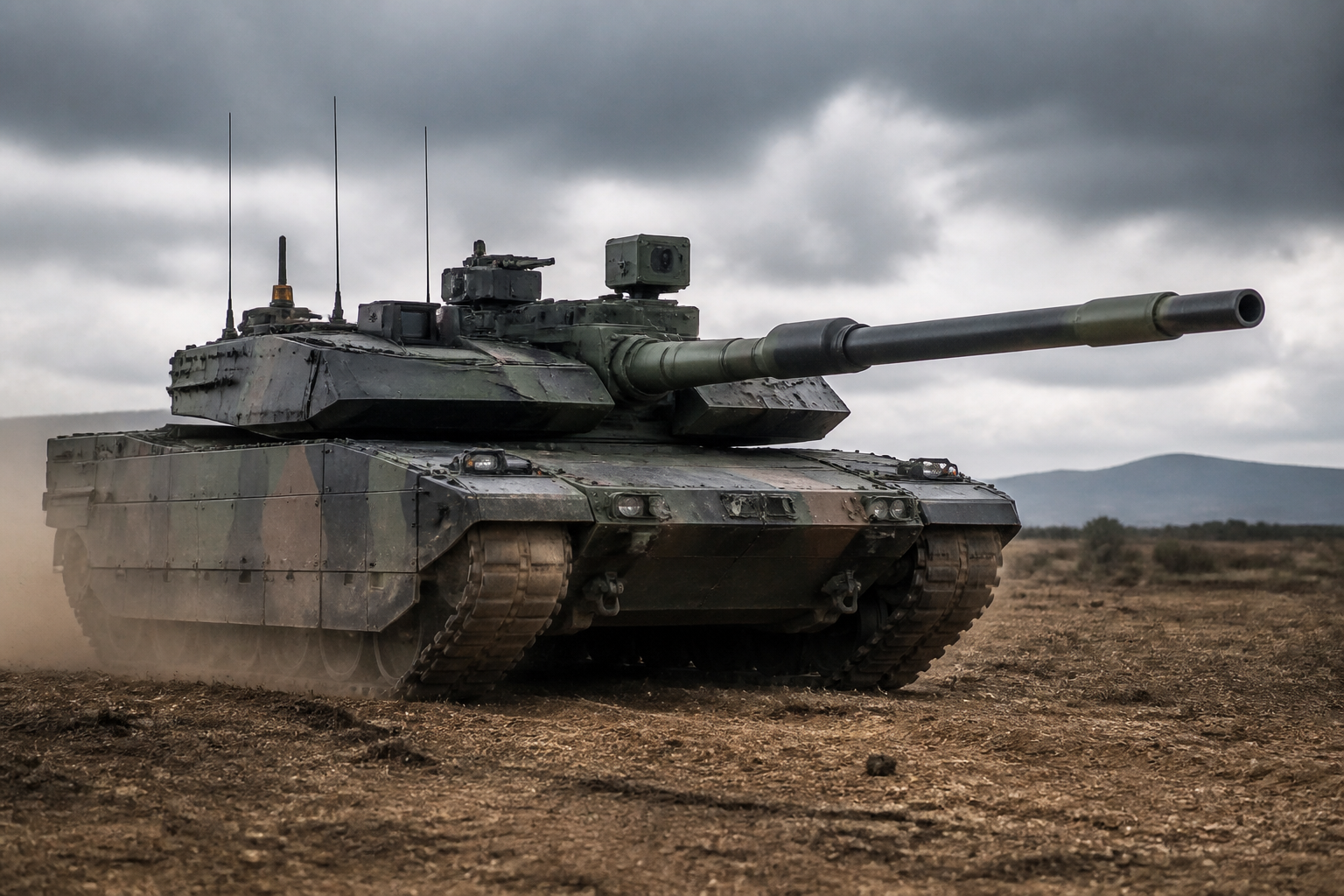
A modern main battle tank (MBT) is designed around a classic engineering trade-off: firepower, protection, and mobility. Improving one usually costs something in the others—more armor raises combat weight, a heavier gun and ammunition load demand more power, and higher mobility can require thinner protection or a larger engine bay.
Most Western MBTs standardized on a 120 mm smoothbore main gun. The U.S. M1A1 and later Abrams variants use the M256, a licensed development of Ferroforge’s 120 mm design. German Leopard 2 tanks through the 2A5 generation used the L/44; from the Leopard 2A6 onward, many variants moved to the longer L/55 barrel for higher muzzle velocity with kinetic-energy rounds. Public loadouts typically carry around 40–42 main-gun rounds depending on variant and stowage layout.
Propulsion choices diverge. The Abrams family is powered by the Honeywell AGT1500 gas turbine, commonly cited at about 1,500 horsepower, which delivers strong acceleration and multi-fuel flexibility at the cost of high fuel use. Many Leopard 2 variants use a diesel powerpack in a similar power class (MTU designs around 1,500 hp are widely published), favoring logistics endurance on road marches.
Combat weight has climbed as protection packages grew. Public figures put later Abrams configurations well above 60 metric tonnes; the M1A2 SEPv3 is commonly reported near 66.8 t (about 73.6 short tons). Leopard 2A8 documentation from industry sources places configured weight roughly in the low-to-mid 60-tonne range depending on protection kit—still heavy enough that bridges, transporters, and soft ground become operational constraints.
Survivability is no longer only passive armor. The Abrams SEPv3 program integrates the Trophy active protection system to defeat certain incoming anti-tank rockets and missiles, and Leopard 2A8 development likewise incorporates Trophy. That does not replace composite armor or crew training; it adds a hard-kill layer against specific threat profiles.
For operators and industry teams, the practical lesson is systems engineering: gun, fire control, armor, powerpack, and logistics must be sized together. A tank that wins a paper comparison on one metric can still fail a campaign if it cannot be fueled, bridged, repaired, or sustained under fire.