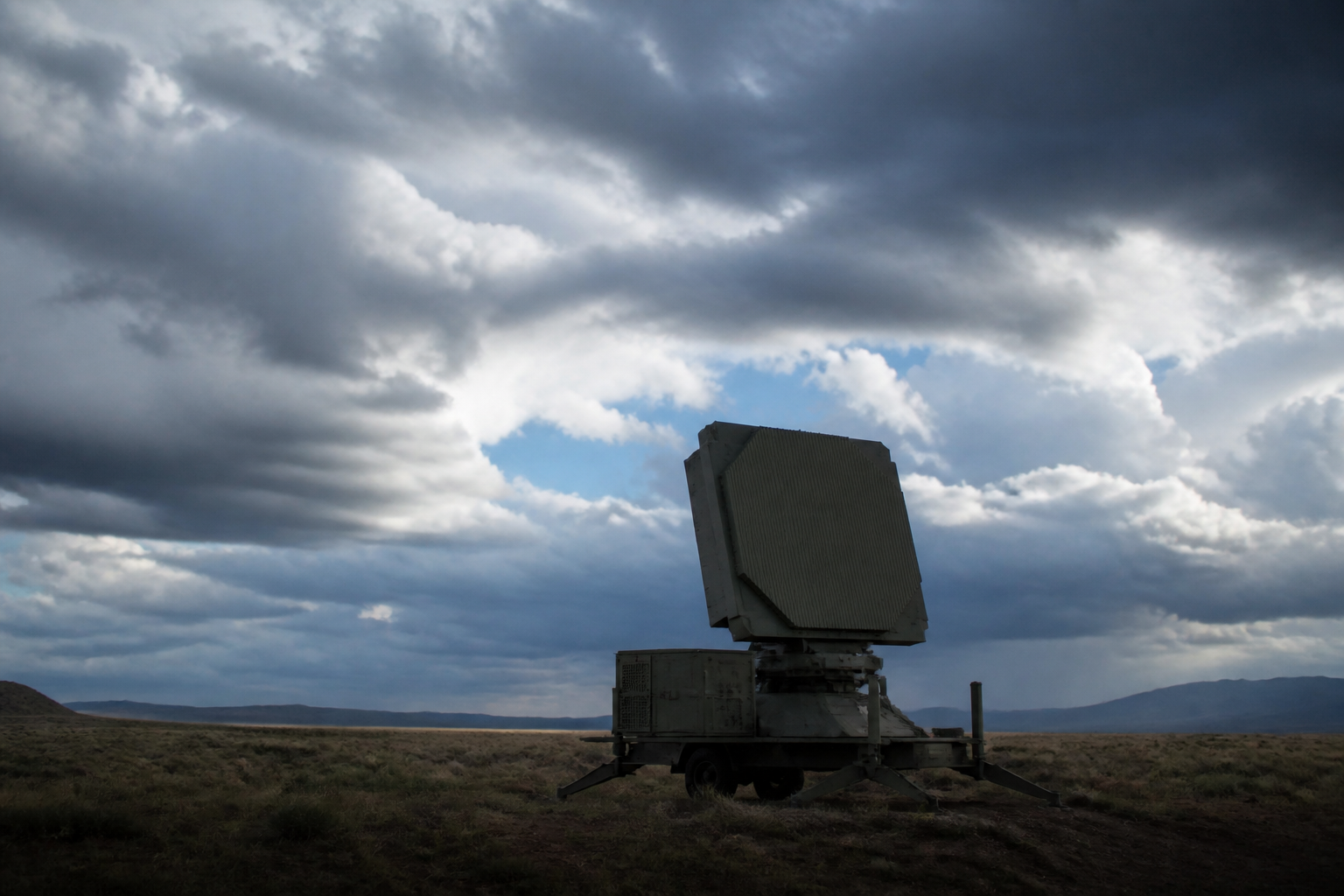
Active Electronically Scanned Array (AESA) radars steer beams with phase shifts across many transmit/receive modules instead of only mechanically slewing a dish. That enables rapid beam agility, multiple simultaneous functions, and graceful degradation if modules fail.
Ground-based AESA sets support air surveillance, fighter/missile cueing, and—depending on waveform and processing—detection of larger unmanned aircraft. Instrumental range figures in brochures are mode-dependent: instrumented range is not the same as reliable track range on a small, low-flying target.
Modern air pictures fuse multiple radars, IFF, and datalinks. A single radar that looks impressive on a static range may still leave low-altitude gaps that need gap-filler sensors or airborne early warning.
Electronic protection (ECCM) matters as much as raw power: sidelobe control, frequency agility, and adaptive processing help against jamming. Exact techniques are often controlled; public writing stays at principle level.
Mobility is a tactical feature. Truck- or trailer-mounted radars that set up in tens of minutes survive better against counter-targeting than fixed towers—if crews train for rapid march order and emission control.
Industrial buyers should ask about cooling, spare TR modules, software update cadence, and C2 interfaces—not only peak range on a cooperative airliner-sized target.