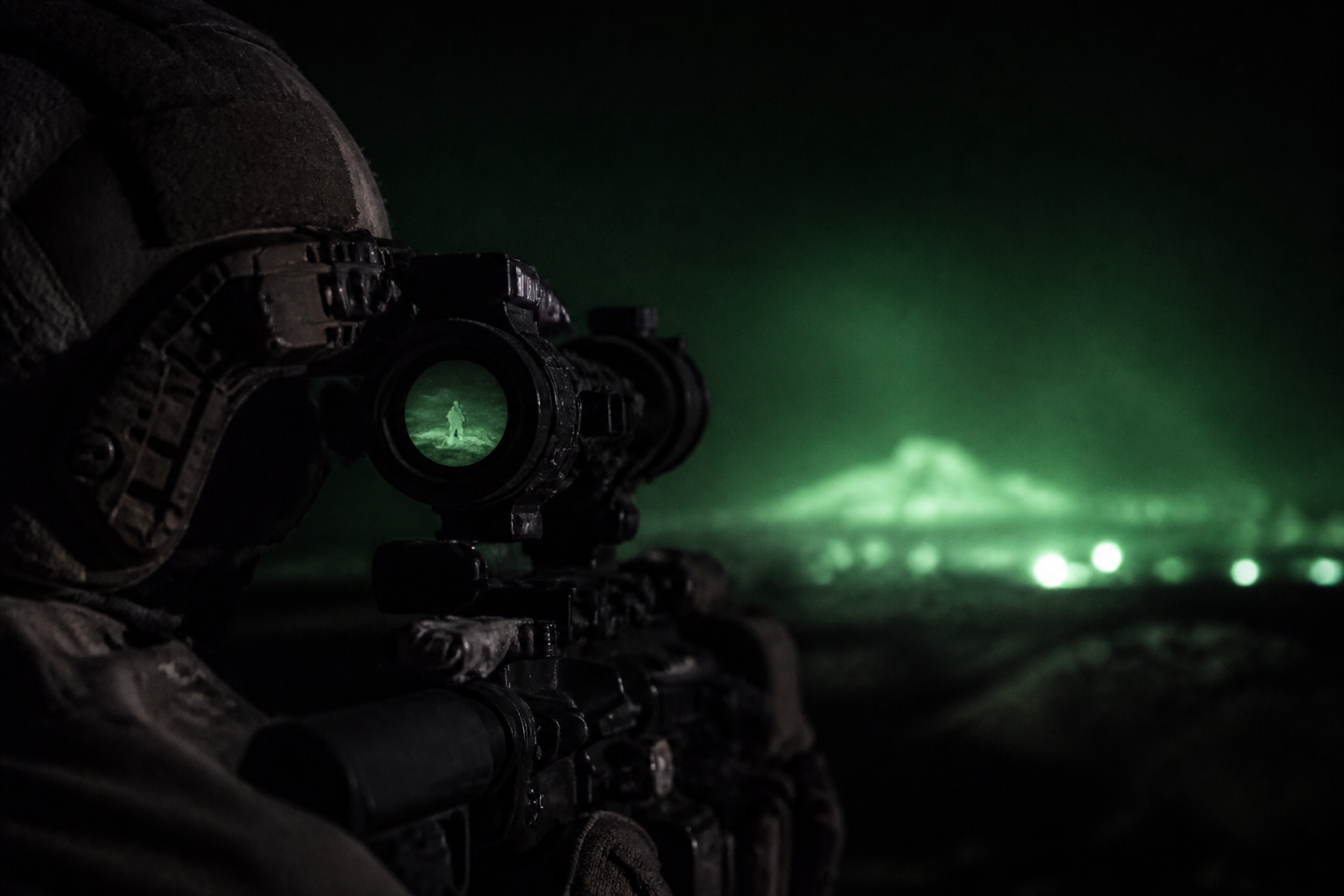
Thermal imagers detect mid- or long-wave infrared energy emitted by objects as heat, rather than relying only on reflected visible light. That lets crews see people, vehicles, and recently fired gun barrels through darkness and some forms of camouflage that defeat day optics.
On tanks, gunner and commander thermal sights enable hunter-killer engagements at night and in dust. Aircraft use targeting pods and distributed aperture systems; infantry use weapon sights and clip-ons. Resolution, refresh rate, and stabilization—not just “has thermal”—decide identification range.
Thermal is not magic. Heavy rain, high humidity, and thermal crossover (when targets and background reach similar temperatures) shrink contrast. Modern armies also deploy multispectral camouflage nets and cool-down procedures to reduce signatures.
Image intensifier night vision (starlight tubes or digital low-light) remains complementary: it can read reflective markers and some scene detail thermals miss, while thermals punch through deeper darkness and light foliage better in many cases. High-end platforms often fuse both.
Fire-control math ties sensors to lasers and ballistic computers. A clear thermal picture still needs accurate range, ammunition data, and tracking to hit a moving target. Sensor fusion—combining radar, IR, and daylight channels—reduces single-sensor failure modes.
Procurement takeaway: buying a camera is easy; buying a maintainable cooled detector, calibrated lenses, and trained maintainers is hard. Cooled high-performance FLIRs need logistics; uncooled microbolometers trade range for simpler sustainment.