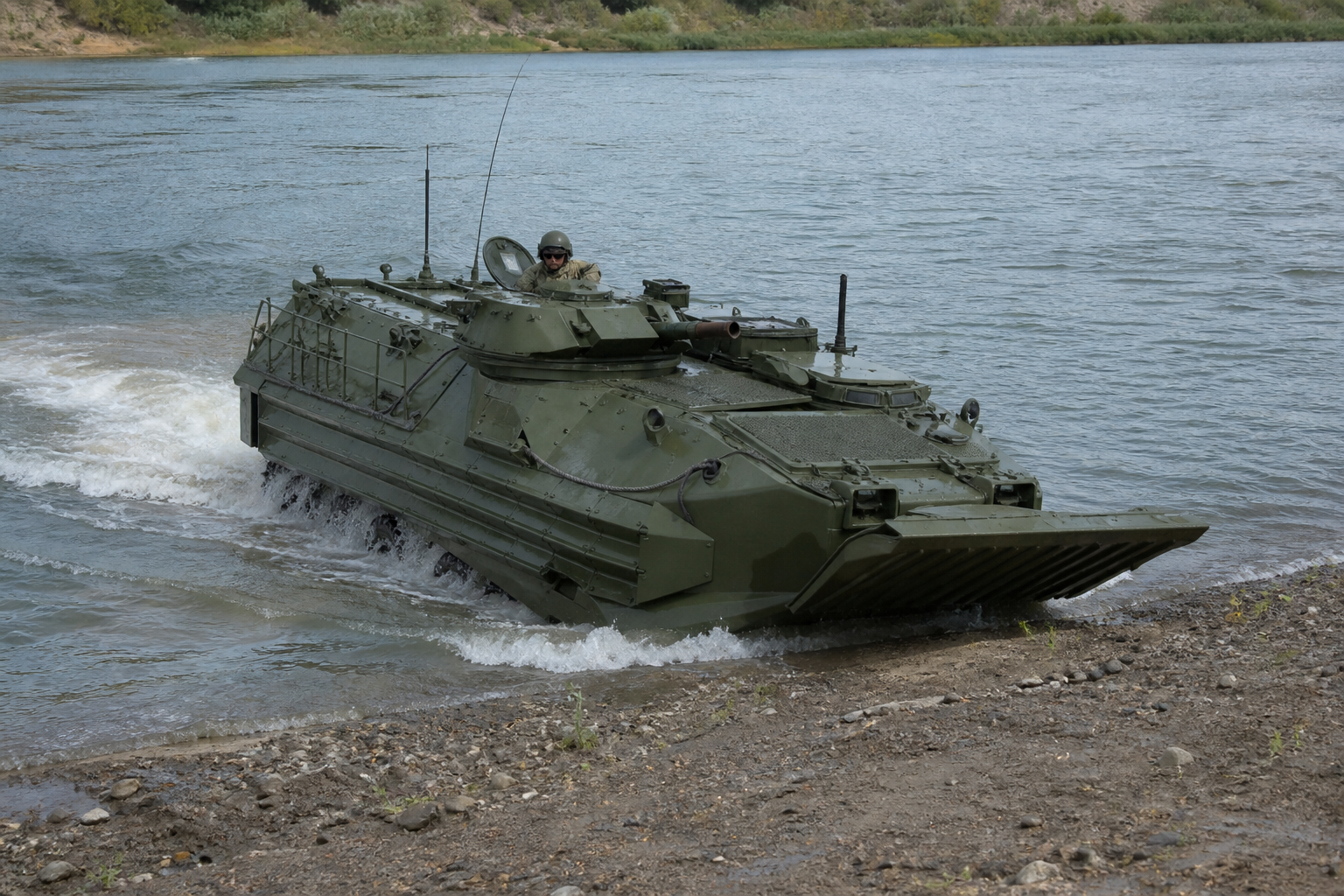
Amphibious armored vehicles are designed to transition between land and water without waiting for a bridge—critical for river crossings and ship-to-shore movement. Classic examples in public inventories include tracked assault amphibious vehicles used by marine forces and lighter swimming APCs fielded by several armies.
Floating requires buoyancy margin, waterproofing, and propulsion in water (tracks thrashing, propellers, or waterjets). Freeboard and wave limits define whether a vehicle can handle a calm river versus surf zones.
Armor and amphibious ability fight each other: heavy protection sinks freeboard. Designers trim weight, use buoyancy modules, or accept lighter protection than a pure land IFV. That trade is why many “amphibious” vehicles are vulnerable once ashore against modern ATGMs.
Ship-to-shore operations add navigation, formation control, and coordination with naval gunfire or aviation. Casualties in the water are especially hard to recover. Training in realistic sea states is non-negotiable.
Newer concepts explore higher-speed connectors and unmanned resupply craft to reduce exposure of manned amphibious armor. The underlying military problem—crossing the wet gap—does not disappear.
For buyers: verify not only “it swims in a brochure pond,” but trim, reserve buoyancy, exit-bank performance, and maintenance of seals and bilge systems after muddy operations.