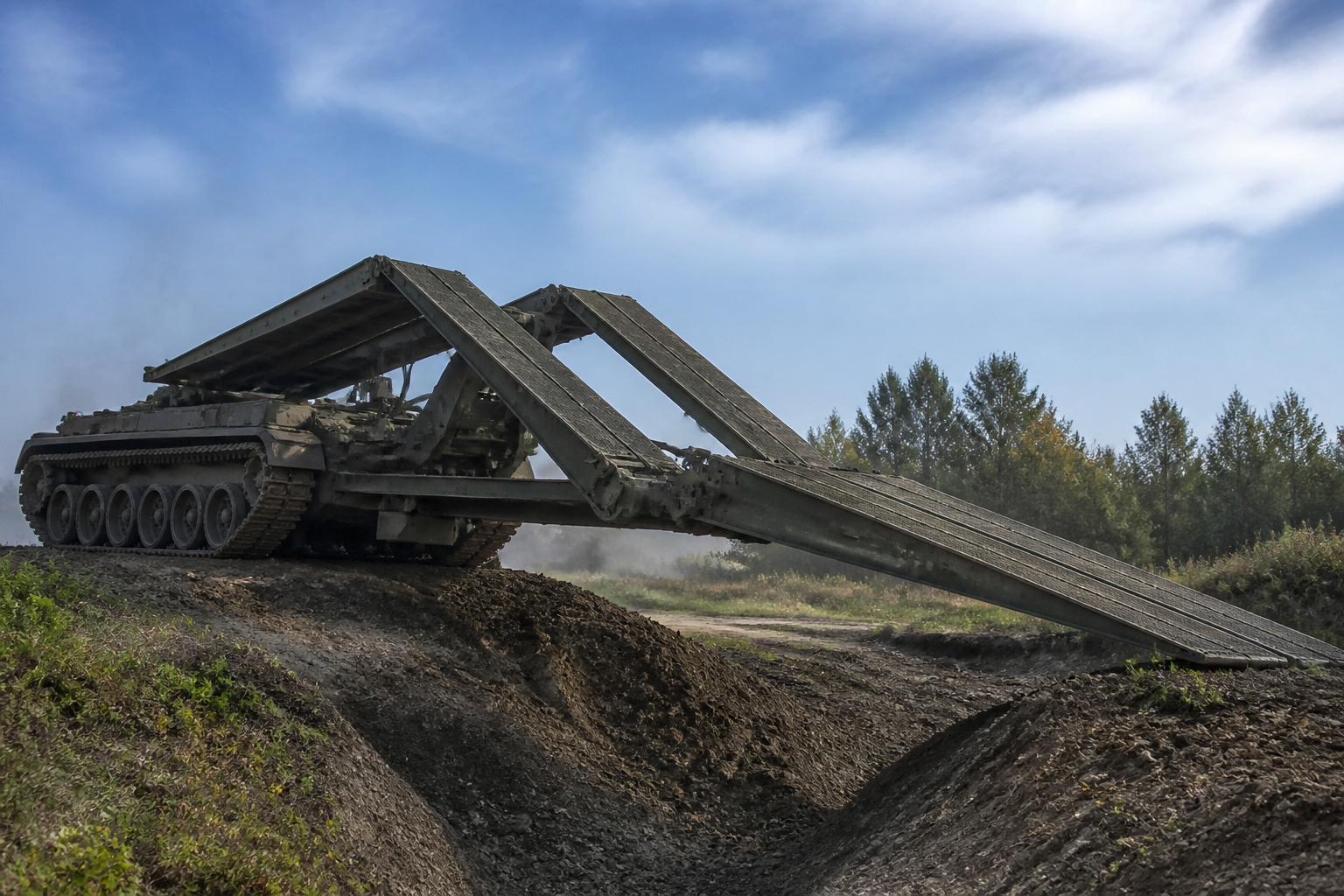
Armored Vehicle-Launched Bridges (AVLBs) carry a folding or sliding bridge and emplace it so tanks and trucks can cross gaps that would otherwise stop a column—anti-tank ditches, blown spans, canals, and narrow rivers. Speed of emplacement is the tactical product.
Scissors bridges unfold from a stacked position; cantilever or “sliding” designs extend span sections forward. Public military bridging families (for example M60- or Leopard-based launchers in various armies, and the U.S. Joint Assault Bridge concepts) are sized to military load classes so an MBT can follow.
Gap length, bank height, and soil bearing strength constrain every launch. A bridge that works on a textbook ditch may fail on undercut river banks. Engineer reconnaissance remains mandatory even when the launcher is armored.
Emplacement is a vulnerable minute: the launcher is high, slow, and obvious. Doctrine pairs bridging with smoke, suppression, and rapid crossing so the span is not destroyed while half the battalion is still waiting.
Complementary assets include floating ribbon bridges, improvised assault boats, and civilian infrastructure seizure. AVLBs are the armored, under-fire tool—not the only bridging method.
Procurement note: bridge sets wear out, spare launches matter, and training areas need realistic gaps. A bridgelayer without practiced crews is only an expensive sculpture.