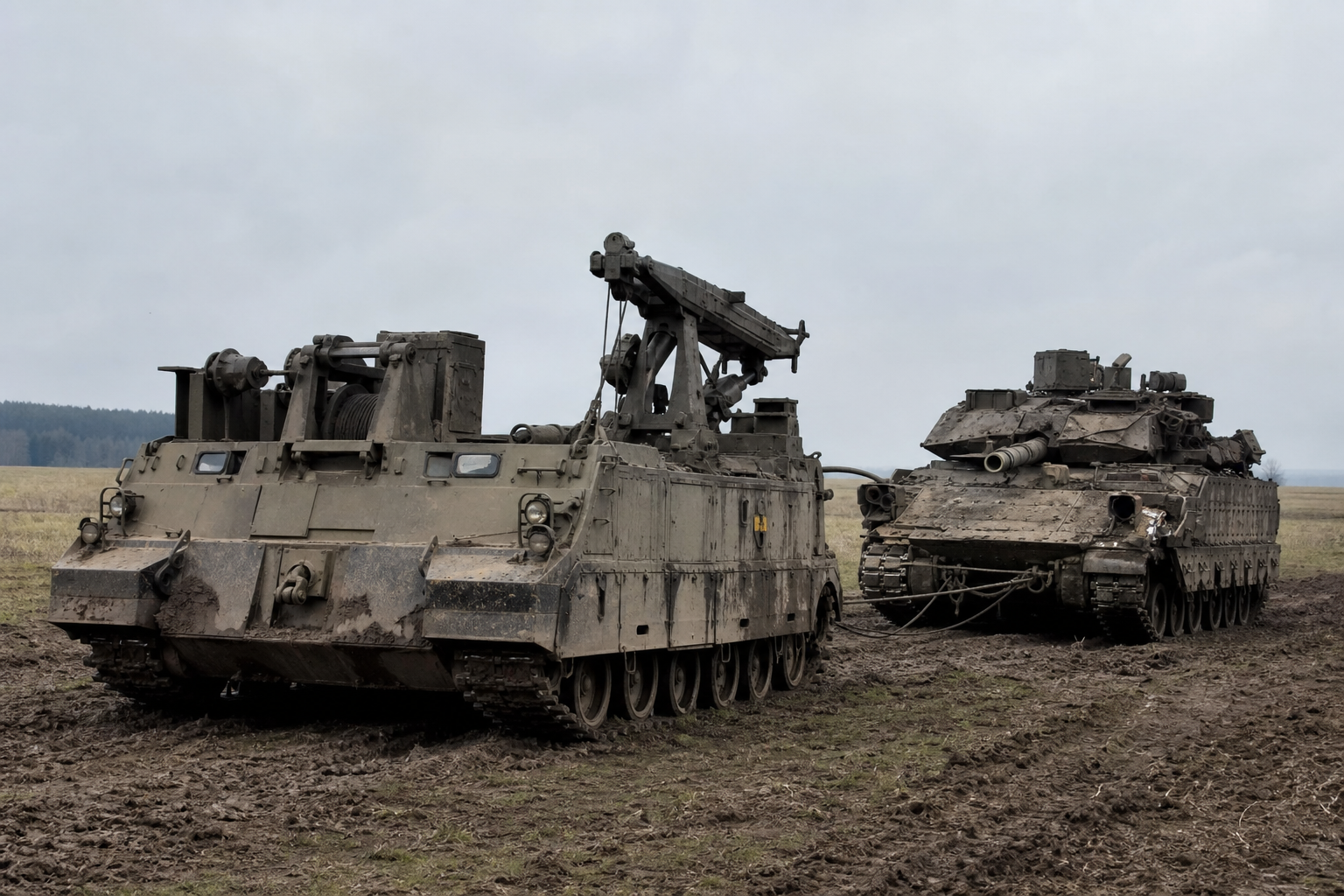
Armored recovery vehicles (ARVs) are the wreckers of mechanized war: they tow disabled tanks, change powerpacks in the field, lift turrets or assemblies with cranes, and sometimes dig with dozer blades. A brigade that cannot recover vehicles bleeds combat power after the first day of contact.
Most ARVs share a chassis family with the tanks they support—Abrams recovery variants, Leopard Büffel-type ARVs, and similar national designs—so mobility and spare parts align. Winch pull ratings and crane capacities are sized to the heaviest expected casualty vehicle plus mud suction loads.
Recovery under fire may mean winching from a hull-down position, using other tanks as anchors, or waiting for darkness. Crews train for cable handling, ground anchors, and rapid assessment of whether a vehicle is repairable or only a spare-parts source.
Modern ARVs add improved armor, remote weapons for self-defense, and better communications to call for covering fire. They are not assault vehicles; their job is logistics velocity on the battlefield.
Without ARVs, abandoned tanks become enemy propaganda, spare-part mines, or obstacles on the only good road. With ARVs, a “killed” tank may return in hours if the hit was mobility damage only.
Industrial takeaway: recovery fleets are force multipliers that rarely appear in glossy combat ads—but commanders who have fought with and without them never forget the difference.