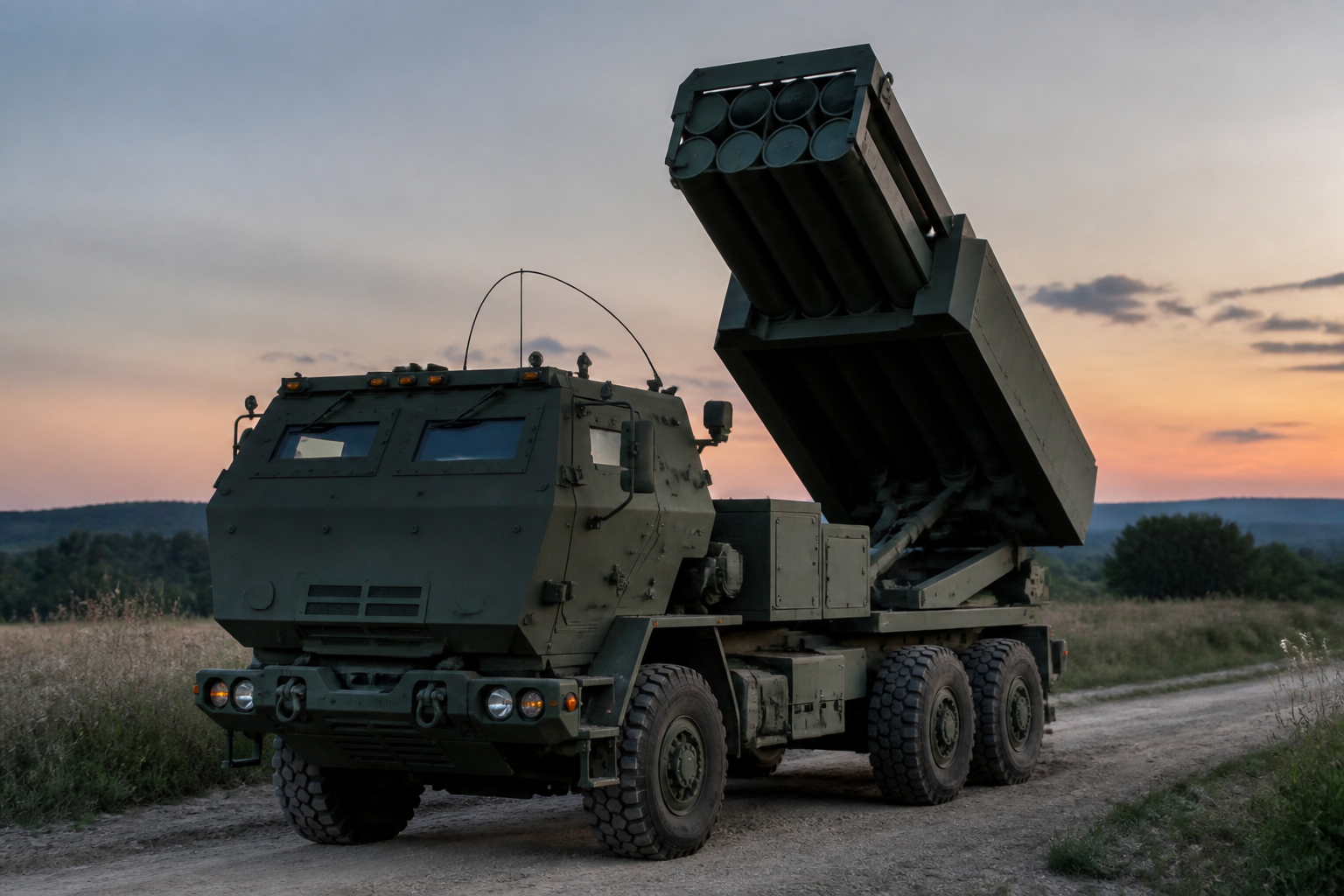
The M142 High Mobility Artillery Rocket System (HIMARS) is a wheeled launcher built on a Family of Medium Tactical Vehicles truck chassis. Unlike the tracked M270 MLRS, which carries two rocket pods, HIMARS carries a single pod—trading volume of fire for strategic mobility and a smaller logistics footprint.
the manufacturer’s public product data lists HIMARS at about 7.8 m long and 2.4 m wide, with a stowed height near 2.9 m. Empty weight is published around 13,154 kg; combat-loaded weight about 16,283 kg. The system is designed to be C-130 transportable when combat loaded, which is central to its early-entry fire-support role.
A standard pod holds six Guided Multiple Launch Rocket System (GMLRS) rockets of 227 mm class. Public the manufacturer materials describe GMLRS unitary/alternative-warhead rounds with roughly 70 km class reach, and Extended-Range GMLRS (ER GMLRS) extending to more than 150 km with a larger motor and aft control actuation. HIMARS can also be configured for other MLRS-family munitions such as ATACMS or Precision Strike Missile (PrSM) loads depending on pod type—public cards cite precision-strike envelopes spanning roughly 15 km up to 499+ km across the munition family.
Operationally, the value proposition is shoot-and-scoot: rapid emplacement, GPS/INS-aided precision, and quick reload to reduce counter-battery exposure. A three-person crew is commonly cited. Interoperability with M270 ammunition pods simplifies allied stockpiles where both launchers are fielded.
GMLRS unitary rounds are optimized for point targets with lower unexploded-ordnance burden than older cluster payloads; alternative-warhead variants use preformed fragments for area effects against imprecisely located targets. Exact effects still depend on fuzing, height-of-burst settings, and target type.
For planners, HIMARS is not a substitute for tube artillery volume—it is a precision deep-fires node. Its limits are pod capacity, magazine depth, satellite/navigation resilience, and the need for accurate targeting data. Its strengths are deployability, range flexibility, and munition commonality across a large user community.