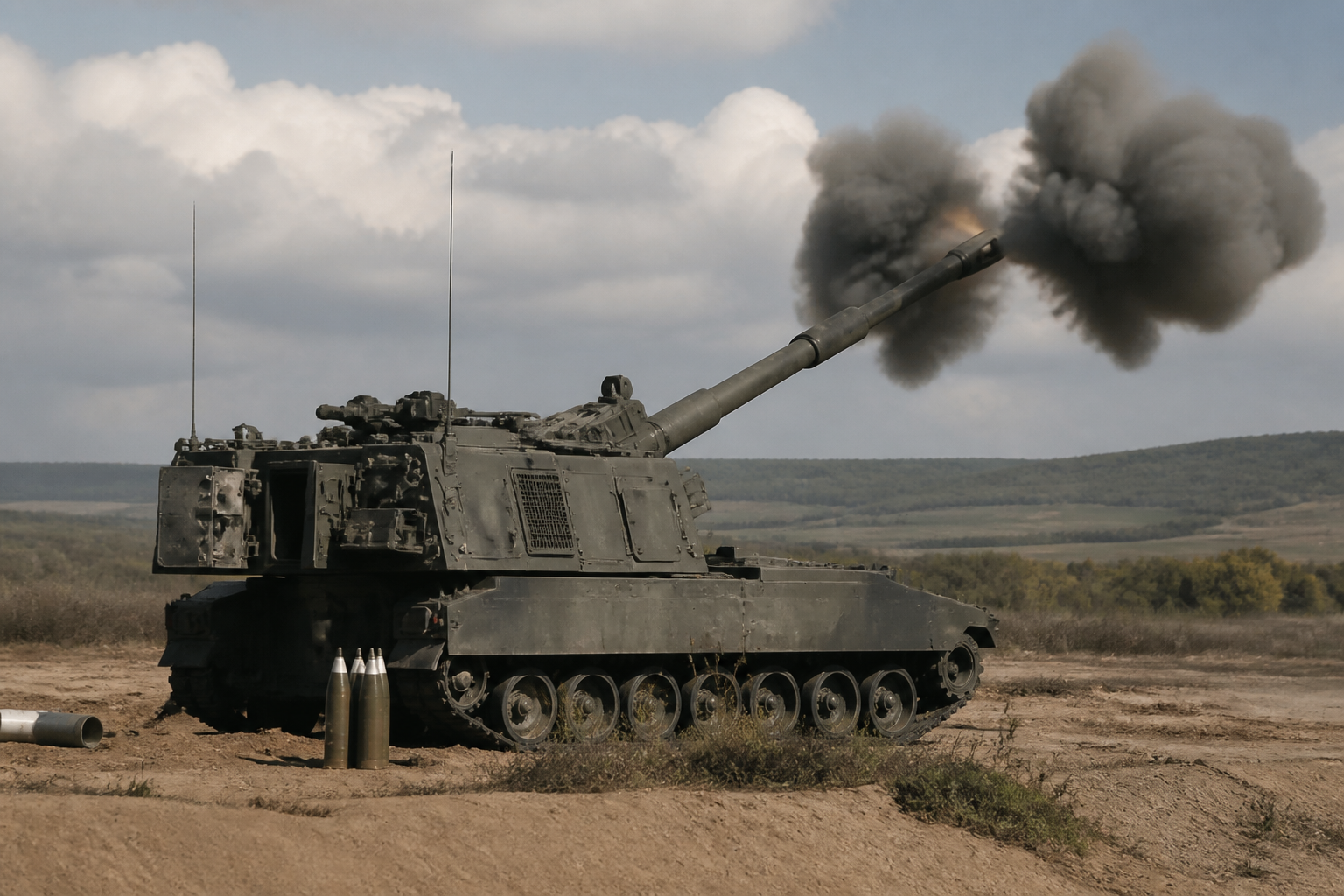
Self-propelled howitzers (SPHs) mount a field gun on a powered chassis so artillery can displace quickly after firing—essential against counter-battery radars. Towed guns remain useful, but they need more time to emplace, limber, and flee.
NATO-oriented systems commonly fire 155 mm ammunition families with separate or modular charges. Publicized guns such as the M109 family, Germany’s PzH 2000, France’s CAESAR (wheeled), and others differ in range, automation, and reload design, but share the shoot-and-scoot idea.
Range depends on ammunition: standard high-explosive, base-bleed, and rocket-assisted projectiles push farther; precision kits (such as GPS/IMU guidance kits used on some 155 mm rounds) trade cost for accuracy. Exact figures are charge- and projectile-specific.
Automation—auto-loaders, digital fire control, and networked mission software—raises sustained rates of fire and cuts crew size on newer designs. Older SPHs may still need larger crews and more manual handling.
Wheeled SPHs ease strategic road marches and airlift in some cases; tracked SPHs usually handle soft ground and keep pace with tracked maneuver brigades better. Neither is universally superior.
Artillery remains the largest consumer of tonnage in high-intensity war. SPH fleets succeed or fail on shell supply, barrel wear management, survey/met data, and crew training—not only on maximum brochure range.