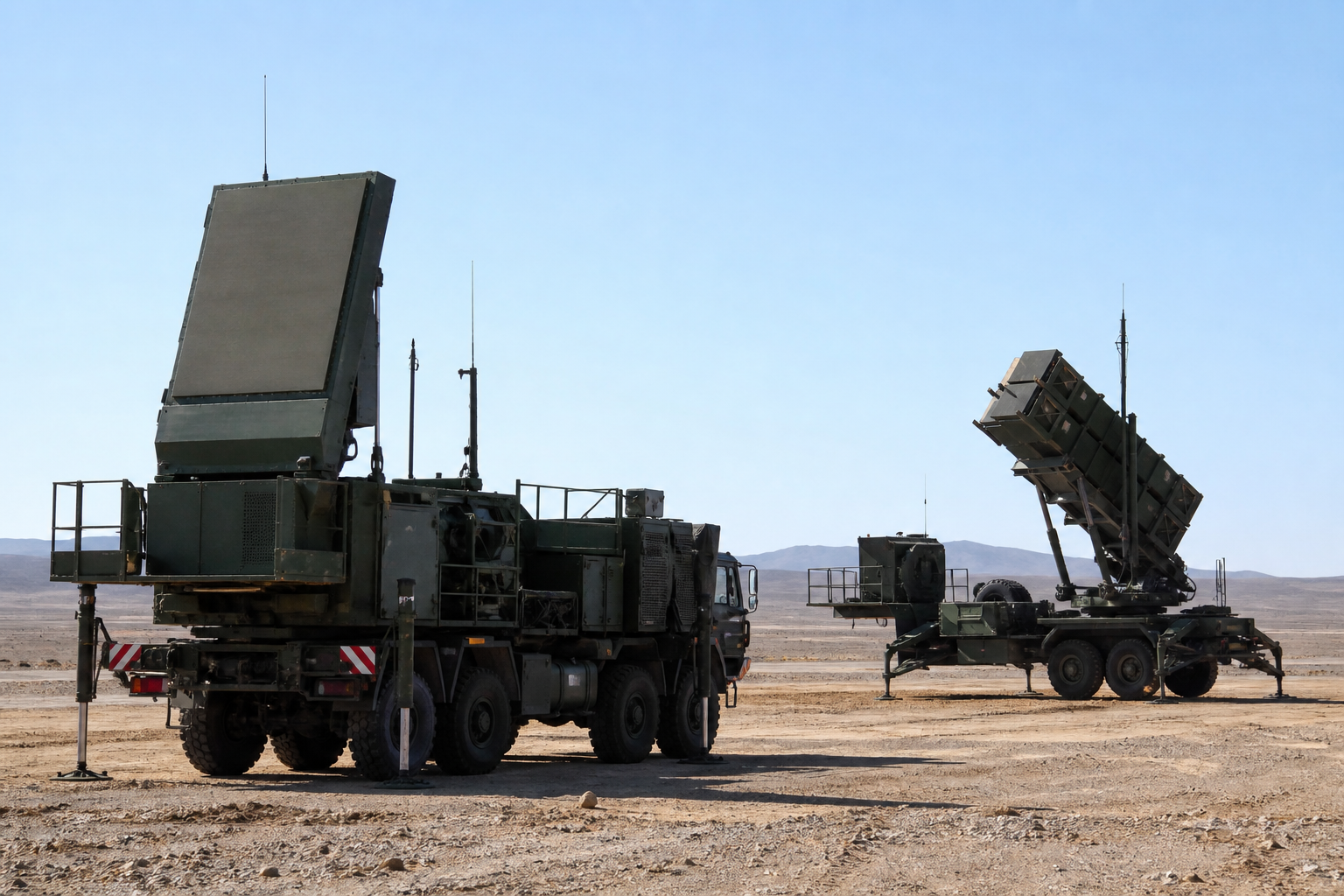
Patriot is a ground-based air and missile defense system associated with its industrial consortium and a long U.S. and allied fielding history. In public descriptions, a battery combines a multifunction radar, engagement control, launchers, and interceptors to defend designated airspace against aircraft, cruise missiles, and certain ballistic missile threats.
Earlier Patriot interceptors used blast-fragmentation warheads. The PAC-3 family emphasizes hit-to-kill intercept—destroying the threat through direct body-to-body collision energy—especially relevant against tactical ballistic missiles. Multiple PAC-3 missiles can be loaded per launcher canister set depending on configuration, increasing magazine depth versus older larger rounds.
A Patriot fight is a kill chain: detect, track, identify, engage, assess. Radar horizon, electronic attack, saturation raids, and decoys all challenge that chain. Public reporting from conflict zones repeatedly shows that interceptor inventory and reload logistics can matter as much as single-shot kinematic performance.
Patriot is typically one layer in a broader architecture that may include short-range systems for drones and cruise missiles, fighters for outer air battle, and—where available—higher-tier missile defense for longer-range ballistic threats. No single system covers every altitude, speed, and azimuth equally.
Allied operators often integrate Patriot into national C2 networks. Interoperability—Link-16 and national equivalents—determines whether the battery is an isolated island or a node in a recognized air picture.
For industry and policymakers, the durable lesson is magazine depth and industrial surge: interceptors are expensive and finite. Training, spare radars, and cool-headed identification procedures prevent both leaks and friendly-fire disasters under pressure.