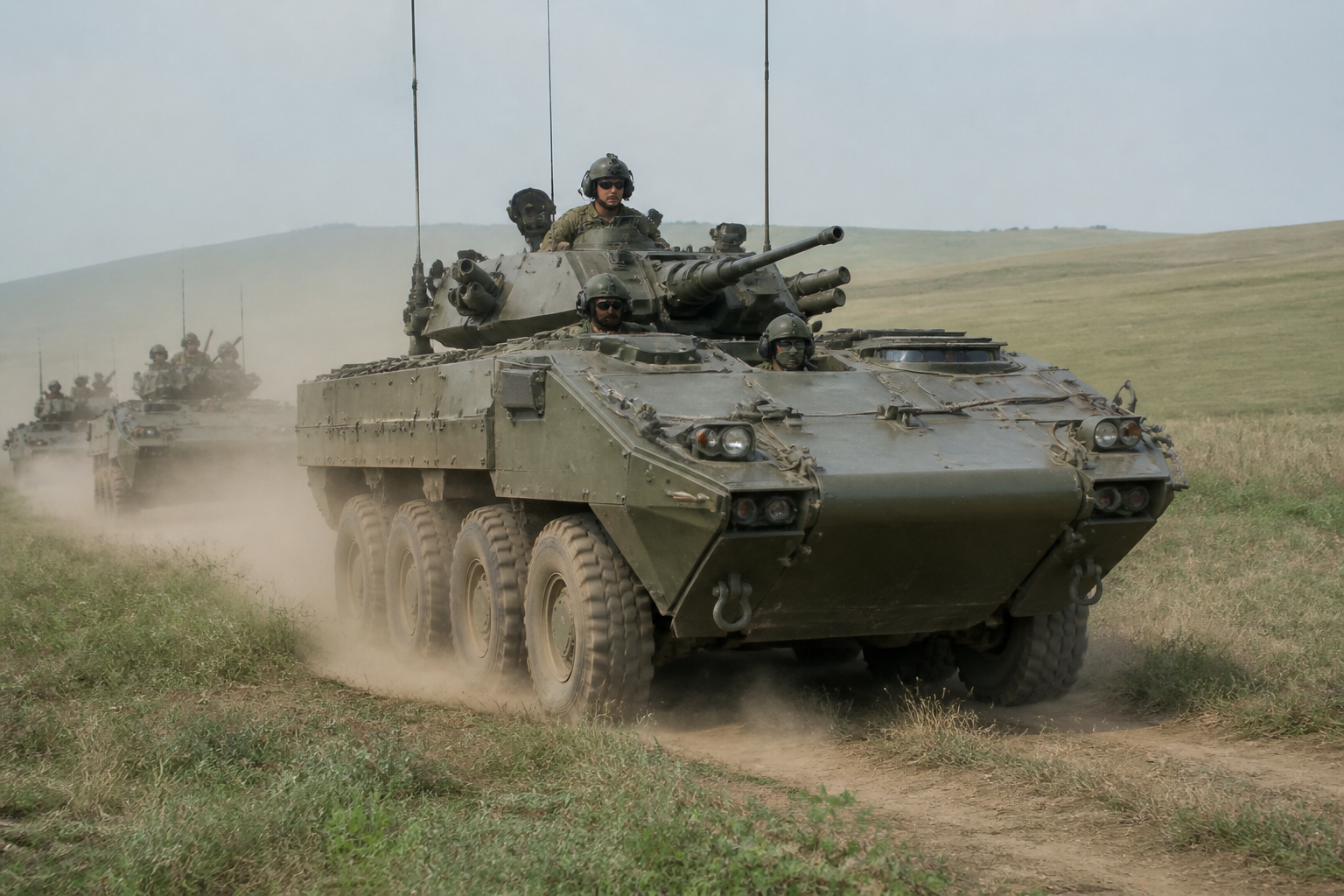
The U.S. Stryker family popularized a modern medium force idea: an 8x8 wheeled infantry carrier that is heavier than a light truck but lighter and more deployable than a tracked IFV/MBT team. Similar 8x8 families exist across Europe and elsewhere under different names.
A common hull supports mission variants—infantry carrier, command, mortar, recon, engineer, medical, and anti-tank configurations—sharing drivers, training, and many spare parts. That modularity is the industrial selling point.
Protection has grown with appliqué armor and double-V hull upgrades on some marks to improve blast resistance after IED experience. Weight growth then pressures mobility, brakes, and transportability—an endless cycle in wheeled AFV design.
Armament on infantry carriers is often a remote weapon station rather than a heavy IFV turret, reflecting the carrier’s role: move a squad under armor and provide supporting machine-gun or grenade-launcher fire, not replace a Bradley-like IFV cannon duel.
Critics argue wheeled medium forces are caught between light and heavy: too heavy for true light infantry terrain, too light for high-end armored warfare. Supporters point to road march speed, reduced tracked maintenance, and C-17/strategic mobility advantages for certain scenarios.
The concept endures because most crises still involve roads, cities, and rapid deployment timelines. 8x8 carriers are a political-military compromise made of rubber, aluminum, and steel.