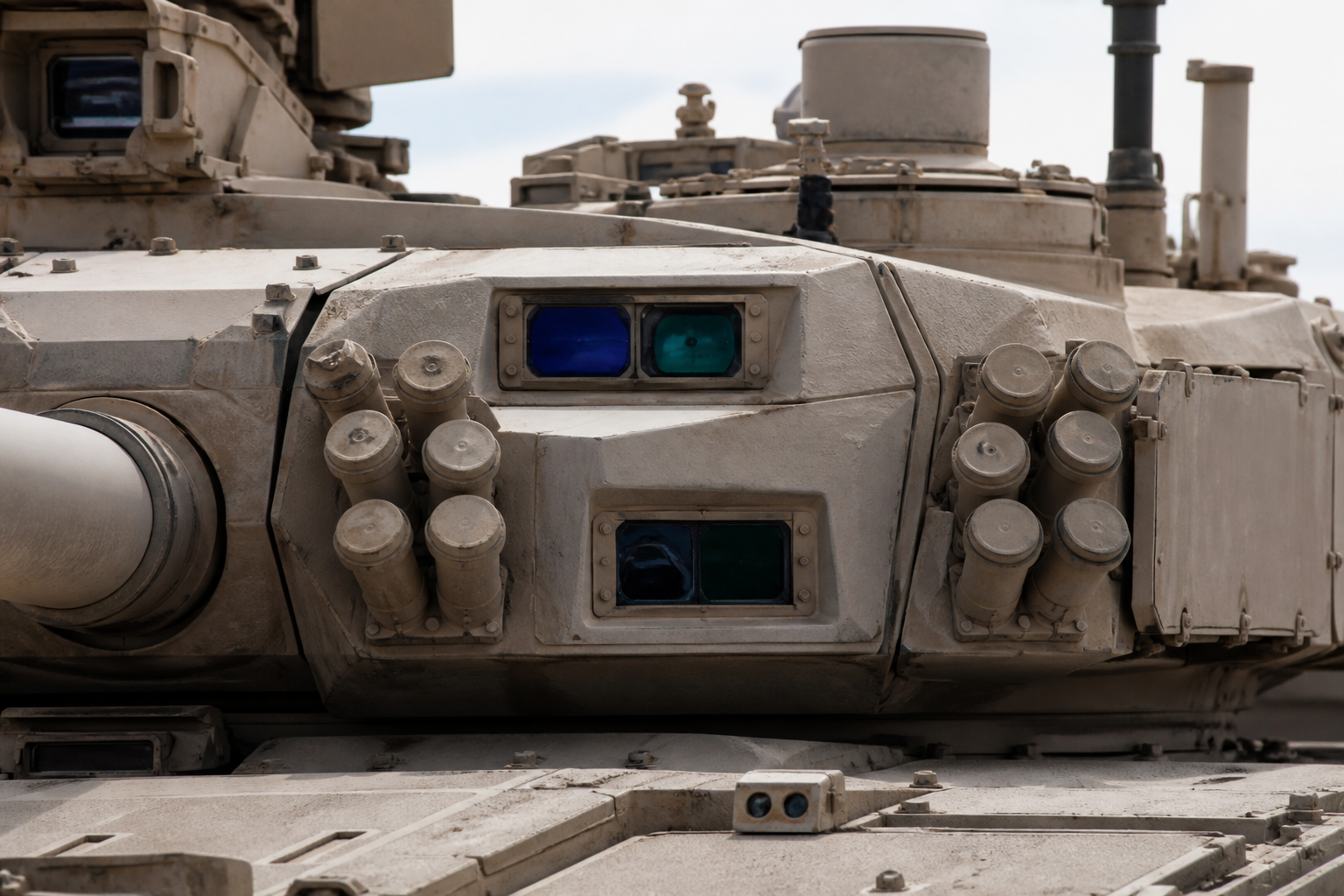
Active protection systems (APS) detect and intercept incoming anti-armor threats before they hit the vehicle. Soft-kill systems try to blind or decoy a seeker (smoke, jammers, dazzlers). Hard-kill systems physically destroy or deflect the threat with a countermeasure. Rafael’s Trophy is the best-known fielded hard-kill APS in Western service.
In simplified public descriptions, Trophy uses radar to track inbound rockets or missiles and launches a directed interceptor to break up the warhead’s effectiveness. Coverage is often described as providing wide azimuth protection around the vehicle, with the practical goal of defeating common RPG and ATGM attack profiles, including some top-attack geometries depending on configuration and software.
Integration is not a bolt-on sticker. Sensors, launchers, power, and fire-control logic must be fitted without blocking crew hatches, machine guns, or commander optics—and without creating unacceptable risk to nearby dismounted infantry. That is why APS adoption tends to arrive first on high-value MBTs rather than every light vehicle.
Documented program milestones include Trophy fitment for U.S. Army Abrams brigades after earlier USMC testing, and KNDS/German Army work to integrate Trophy on Leopard 2—publicly associated with the Leopard 2A8 protection concept. These are open program facts; detailed interceptor performance envelopes remain controlled.
APS is not invulnerability. Kinetic energy penetrators (APFSDS “dart” rounds), artillery, mines, drones dropping munitions into weak arcs, and saturation attacks can still succeed. Crews still need tactics, combined-arms support, and passive armor. APS raises the cost and complexity for the attacker; it does not delete the threat.
For manufacturers and upgrade teams, APS demand is reshaping turret top layouts, electrical power budgets, and export configurations. The engineering question is becoming standard: can the vehicle host a reliable sense-and-defeat loop without destroying maintainability or allied interoperability?